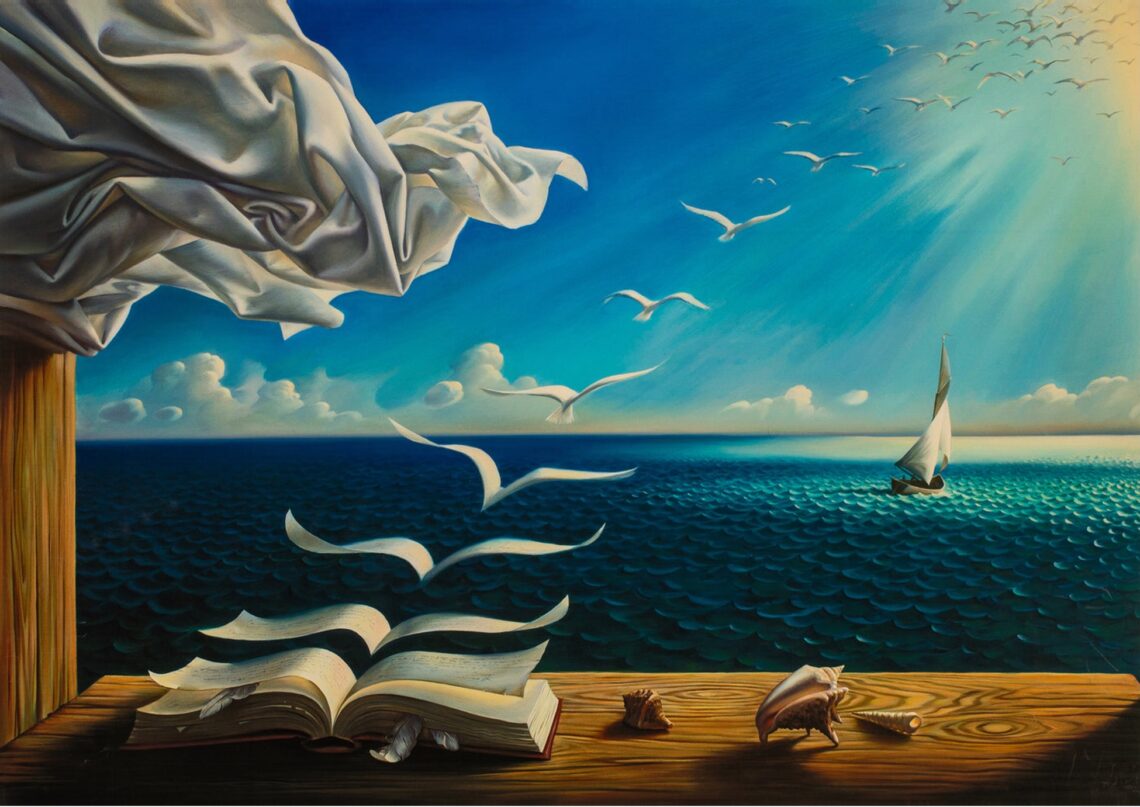

The Swirling Chaosmos of Fate: Predestination, Individual Will, and the Ocean in Moby Dick and Middle Passage
Fate, as both a word in the English language and a broader literary concept, is difficult to define because fate, like the ocean, is chaotic, fluid, and yet somehow, ordered. It is easy to provide a general encapsulation of the meaning of the word, but pinning down the more abstract and even metaphysical components of fate is no small task. The Oxford English Dictionary provides four primary definitions for fate, each of which captures a small component of the larger whole. The first definition sees fate as “the principle, power, or agency by which, according to certain philosophical and popular systems of belief, all events, or some events in particular, are unalterably predetermined from eternity. Often personified.” In simpler words, fate is a force of predestination that dictates the outcome of events, and by extension, people’s lives, before they happen. This force of fate is often personified, something that is expanded upon in the second definition, which defines fate as “a. the goddess of fate or destiny; in Homer Μοῖρα. b. plural. In later Greek and Roman mythology, the three goddesses supposed to determine the course of human life.” In various mythologies, the concept of fate has been given physicality and agency through deities such as Clotho, Lachesis, and Atropos, the three goddesses of fate in Greek and Roman mythology. These deities are then responsible for weaving the fates of people, sometimes literally. In fact, this definition of fate as a god or multiple gods is where fate’s etymological history begins.
The word fate originates from the Latin fātum, meaning “that which has been spoken.” The Oxford English Dictionary states that “the primary sense of the Latin word [fātum] is a sentence or doom of the gods.” The fourth definition of fate continues in that direction, defining it as “a. What will become of, or has become of (a person or thing); ultimate condition; destiny. b. Death, destruction, ruin.” In the literary world, being fated usually means being fated to death—or to a fate worse than death, and overcoming that fate requires a nearly impossible strength of will. Finally, the third definition is closest to fate’s place in the modern vernacular, meaning “that which is destined or fated to happen. Predestined events.” Taken together, these four definitions of fate solidify it as something with an etymology rooted in the world of Greek and Roman mythology, something that is often personified—oftentimes as a god, something that is predestined, and something that is usually as negative as it is inescapable.
However, fate’s predestined nature is only one side of the story. After all, what is a story about fate if not a story about fighting and overcoming fate? For as long as the concept of fate has existed, so too has the ideal of a person changing or overcoming their fate existed alongside it. For example, the ancient Greek legend of Admetus sees the titular king befriend the god Apollo, who persuades the three fates to extend Admetus’s life after he discovers that his fated death day is soon to come (Admetus, Encyclopedia Britannica). Predestination is a part of fate, but without its other half of individual will that keeps it in balance, the concept of fate loses all meaning and critical significance. In literature, fate is inherently chaotic, existing as a force that exists in a constant battle between predestination and individual will. It is never clear until the end of a story whether a character will succumb to their fate or overcome it through sheer strength of will. But what happens when a concept as unstable as fate is brought into a space of equal or greater instability? What happens when fate goes out to sea?
The ocean is fundamentally unstable. It is a fluid body of warring currents, complex ecosystems of hundreds of thousands of species, life, death, and rebirth. But alongside the chaos of the ocean, there also exists a certain order. This state of being—this duality where chaos and order coexist and intermingle—can be understood as a chaosmos. First coined by James Joyce in his novel Finnegans Wake, a chaosmos is a fusion of order and disorder—a composed chaos. This chaosmos creates a critical void where frameworks of race, class, gender, and power become destabilized and lose their meanings. Oceanic literature, then, often becomes literature where characters lose all sense of these things and their identities. But can the ocean destabilize fate? Can a character escape their fate by escaping to sea? While the answers to these questions are not set in stone, oceanic literature seems to suggest that not only can the ocean change fate but that the ocean and fate are inseparably linked, and the chaosmos of both is the key.
Fate and the ocean are intrinsically interconnected because fate, like the ocean, is fluid and chaotic, but it also has an inherent order. Fate is a chaosmos where predestined prophecies and individuals will clash and intermingle, while the ocean is a chaosmos where a void of nothingness and limitless meaning exist simultaneously. The chaosmos of the ocean can destabilize the foundations of law, reality, religion, and identity, and in the same way, it can unravel fate. In Herman Melville’s Moby Dick and Charles Johnson’s Middle Passage, two stories built on an oceanic foundation of instability, the ocean becomes a physical embodiment of fate where Ishmael and Rutherford, the narrators and protagonists of each story, respectively, go to escape futures that seem predestined to occur. Ishmael wants to escape from a depressing life on land where he lacks control and escape from a fate of death—perhaps by his own hand, by going to sea and rewriting his own story—past, present, and future. Rutherford craves freedom from slavery and the needs of others, but even more so, he is desperate to avoid the influence of his brother and the shadow of his dead father, a man whose fate he seems cursed to repeat. Ultimately, Ishmael and Rutherford can only unravel their fates by submitting themselves entirely to the ocean and the swirling chaosmos of fate within.
Ishmael begins the story of Moby Dick not with an introduction to the whaling voyage in which he is about to take part or a description of the streets of Nantucket but with a demand of the reader. “Call me Ishmael,” he asks (Melville 16). This opening line heavily implies that “Ishmael” is not the character’s given name but rather a pseudonym he has chosen to take control of how the reader will understand his part in the story. After all, the name “Ishmael” has biblical origins, much like many of the other names Melville chooses for his characters. According to a footnote in the Third Norton Critical Edition of Moby Dick, “the name of the first person narrator implies that he is an outcast from a great family. In the Bible, Ishmael is the oldest son of the patriarch Abraham” who is later outcast into the wilderness (Parker 16). By naming himself after a biblical outcast from a great family, Ishmael asks the reader to imagine him as a figure with a similar backstory, even though there is little evidence in support of that.
Throughout Moby Dick, Melville demonstrates that there is a connection between a character’s name and their fate. A prime example of this is Ahab, who is named after a wicked king of Israel in the Bible. When Ishmael points out this connection to Peleg, Peleg warns never to say such things in front of Ahab. He explains, “Captain Ahab did not name himself. ‘Twas a foolish, ignorant whim of his crazy widowed mother, who died when he was only a twelvemonth old. And yet the old squaw Tistig, at Gay-head, said that the name would somehow prove prophetic” (Melville 73). Ahab’s name is a sensitive subject as he fears that it will dictate his fate—a fate he fights tooth and nail to change by his sheer strength of will. Ishmael also seeks to change his fate, but unlike Ahab, Ishmael does name himself in the story’s opening line. However, this renaming is just the first of several instances where Ishmael seeks control over his story, how it is perceived by readers, and, ultimately, his fate.
Ishmael’s decision to go to sea in the first place can be understood as a means of taking control of his life and escaping whatever fate may await him on land. He explains, “Whenever I find myself growing grim about the mouth; whenever it is a damp, drizzly November in my soul; whenever I find myself involuntarily pausing before coffin warehouses, and bringing up the rear of every funeral I meet […] I account it high time to get to sea as soon as I can […] with a philosophical flourish Cato throws himself upon his sword; I quietly take to the ship” (Melville 16). Ishmael’s account of his reasoning for going to sea brings about not only imagery of anxiety and depression but death and suicide, as evidenced by his reference to Cato—a Roman statesman soldier who committed suicide after losing in battle. Ishmael suggests that the fate he seeks to escape by going to sea is one of death—possibly by his own hands. Strangely, Ishmael later casts his decision to go to sea as a fate decided for him by the gods. In reference to the Greek and Roman understanding of fate as goddesses, Ishmael perceives his fate as an “invisible police officer of the Fates, who has the constant surveillance of [him], and secretly dogs [him], and influences [him] in some unaccountable way” (Melville 19). While Ishmael sees going to sea as a choice that he made, he doubts whether he made the choice of his own free will, imagining instead that this “police officer of the Fates” manipulated him into the decision. Notably, this “police officer” is seen as an aspect of fate that influences Ishmael rather than fate in its entirety. Perhaps this figure is simply the embodiment of Ishmael’s fear that his fate is not under his control. Nevertheless, Ishmael’s conceptualization of fate solidifies it as something that is made of multiple aspects—a will that makes decisions and a force of predestination that attempts to manipulate that will.
Rutherford Calhoun is a formerly enslaved man who was granted freedom, and as such, that drive for freedom seems to influence every decision he makes. Rutherford begins his life as a free man in New Orleans, but the illusion of freedom soon dissipates as he is blackmailed into marrying Isadora. In a desperate move, Rutherford sneaks onto the slave ship the Republic in an attempt to preserve his freedom by going to sea. However, as the story continues and more of Rutherford’s past is uncovered, it becomes clear that his desire to depart from the land is driven by much more than freedom. Rutherford grew up alongside his older brother, Jackson, after their father, Riley, ran away from slavery in search of freedom when Rutherford was three. Rutherford and Jackson were, in many ways, polar opposites. “As you might guess, I was his shadow self,” Rutherford says (Johnson 112). Where Jackson was selfless, obedient, and godly, Rutherford was selfish, stubborn, and indulgent. Reverend Chandler, the brother’s enslaver, was quick to notice these qualities in Rutherford, predicting that he would be fated to become a thief. Rutherford explains, “The Reverend’s prophecy that I would grow up to be a picklock was wiser than he knew, for was I not, as a Negro in the New World, born to be a thief?” (Johnson 48). Here, Rutherford suggests that he is fated to be a thief not just because of his individual character traits but because thievery is the fate of black men born into slavery. However, while Rutherford is cursed to mirror what the Reverend calls the fate of all black men born into slavery, he is also cursed to repeat the fate of one man in particular—his father. Like his son, Riley Calhoun was selfish, stubborn, and indulgent. He selfishly ran away from slavery while leaving his family behind, leading to a much more difficult upbringing for his two children, who had already lost their mother. It is clear that Rutherford resents his father, at one point stating that he “searched the Illinois farms and streets for fifteen years, hoping to identify this man named Riley Calhoun primarily to give him a piece of [his] mind followed by the drubbing he so richly deserved” (Johnson 111). When Rutherford runs away to sea to chase freedom and escape the fate of thievery that awaits all black men born into slavery—as prophesized by the Reverend—he inadvertently brings himself closer to copying the fate of a father he reviles.
So, as Ishmael and Rutherford escape to sea in an effort to change their fates, an important question must be posed: can the ocean change or erase someone’s fate, and if so, what property intrinsic of the ocean—something fundamental to the ocean’s very being—allows it to unravel fate in this way? In his article “Plunging into the Atlantic: The oceanic order of Herman Melville’s Moby Dick, ” James Weldon Long analyzes the ways in which the novel separates itself from a land-based worldview. Namely, Long examines the fluidity of Moby Dick’s narrative structure—specifically in chapters like “The Masthead,” where Ishmael’s narration takes on the perspective of other characters. There are several moments through Moby Dick where Ishmael narrates events that he could not possibly have bore witness to, such as scenes where Ahab is alone in his cabin. This fluidity of perspective could be justified as Ishmael imagining what took place at times when he was not present—another example of him taking control of and manipulating the story—but it nonetheless reflects the instability of the oceanic foundation upon which the novel is set. Long explains, “Throughout Moby-Dick, Melville employs a fluid perspective that approaches environments from an ocean-based world view, but never collapses them into a totalized whole. The novel preserves the ocean’s diverse nature by acknowledging on a textual level the environment’s actual fluidity” (Long 71). The entirety of Moby Dick, even down to the most minute textual flourishes, is modeled after the ocean, and in doing this, Melville captures something fundamental to the ocean’s very being. The ocean is intrinsically fluid and diverse; it contains multitudes, but those multitudes coexist alongside each other in a state of balance rather than coalescing into one uniform whole.
The textual fluidity of Moby Dick can be better understood in conversation with Leslie Elizabeth Eckel’s article, “Oceanic mirrors: Atlantic literature and the global chaosmos.” In the article, Eckel explores what would happen to the literary study of the Atlantic if an ocean-based rather than land-based worldview were placed at its center. More specifically, Eckel examines the ocean as a global chaosmos that can “obliterate the structure of law, the conventions of morality, the patterns of religious faith, and even life itself” (Eckel 134). Eckel’s view of the ocean as a chaosmos stems from Charles Johnson’s “idea of the ocean as a spiritual ‘chaosmos,’ in which a world that devolves into ‘chaos’ from one perspective may also be recreated from another” (Eckel 130). Because the ocean is a chaosmos that destroys the foundations of human-made concepts like law, race, and class, oceanic theory acts as what Eckel calls a critical void that, when applied to Atlantic theory, can erase predominant disciplinary systems such as “black Atlantic,” “Atlantic history,” and “transatlantic studies” (Eckel 134). However, when Rutherford comes face to face with the spiritual chaosmos of the ocean in the form of the Allmuseri’s god, he faces an annihilation of self—and then a subsequent reawakening. As he encounters the Allmuseri’s god, who has taken on the shape of his father, Rutherford says, “I could only feel that identity was imagined; I had to listen harder to isolate him from the We that swelled each particle of him, as if the (black) self was the greatest of all fictions; and then I could not find him at all” (Johnson 169). At this moment, the lines separating Rutherford’s identity, his father’s identity, and the identities of all black men who have faced similar fates dissolve, and he is left with nothing but emptiness. “Then I fainted. Or died. Whatever,” Rutherford says (Johnson 169). The death or annihilation of self Rutherford experiences allows him to be reborn and, in the process, to change his fate.
Rutherford’s annihilation of self—brought about the chaosmos of the ocean—is rooted in Johnson’s Buddhist philosophy—specifically the ideal of “no self.” In Buddhism, Anatta, or “no self,” is “the doctrine that there is in humans no permanent, underlying substance that can be called the soul” (Anatta, Encyclopedia Britannica). Since Anatta rejects the idea of an unchangeable human soul, it implies that, through an annihilation of self such as that experienced by Rutherford, a person can experience a sort of reawakening where their very identity is obliterated and then reshaped. When viewed from Johnson’s Buddhist perspective, “the emptiness that to Calhoun (and to others who share his Atlantic perspective) may look like defeat actually takes on the positive contours of a shipboard awakening” (Eckel 137). It is through this annihilation of self that Rutherford experiences an annihilation of fate. After all, if individual will is a key component of the chaosmos that is fate, as this essay has posited, an annihilation of self—of the individual—will, in turn, obliterate and rebirth a person’s fate. It is clear by the ending of Middle Passage that both Rutherford’s identity and fate have been reborn. It is only by submitting himself entirely to the ocean and its ability to obliterate and change everything that Rutherford is able to let go of his resentment for his father and brother, his selfishness, and his desire for freedom above all else, finding comfort in a reignited relationship with Isadora. While in many ways, Rutherford returns to the things he sought to escape by going to sea in the first place, he approaches them as a changed person with a new perspective and, in the process, avoids the fate of becoming a selfish and unfulfilled man like his father.
At the end of Moby Dick, after the Pequod sinks and its crew perishes, only one person is left alive: Ishmael. In the epilogue, rather than attributing his survival to his physical strength or quick thinking, Ishmael insists that it was fate that saved him. He says, “It so chanced, that after the Parsee’s disappearance, I was he whom the fates ordained to take the place of Ahab’s bowsman, when that bowsman assumed the vacant post; the same, who, when on the last day the three men were tossed from out the rocking boat, was dropped astern. So, floating on the margin of the ensuing scene, and in full sight of it, when the half-spent suction of the sunk ship reached me, I was then, but slowly, drawn towards the closing vortex” (Melville 410). When Ishmael was thrown overboard, he did not attempt to fight the ocean’s pull. Instead, he submitted his will—and his fate—to the vortex. He continues, “When I reached it, it had subsided to a creamy pool. Round and round, then, and ever contracting towards the button-like black bubble at the axis of that slowly wheeling circle, like another Ixion I did revolve. Till, gaining that vital centre, the black bubble upward burst; and now, liberated by reason of its cunning spring, and, owing to its great buoyancy, rising with great force, the coffin life-buoy shot lengthwise from the sea, fell over, and floated by my side” (Melville 410). Facing nearly impossible odds, Ishmael discovers Queequeg’s coffin in the wreckage and uses it as a buoy. In the process, Ishmael must confront, both physically and symbolically, the prospect of his own death—the fate he went to sea to escape. It is not some unseen “police officer of the Fates” that saves Ishmael’s life here, but the ocean itself, drawing him towards the coffin that he uses to float until another ship comes to save him. In this final scene, the ocean itself becomes a physical embodiment of fate, and when Ishmael submits himself to it and survives, he gains a new purpose in life and finds fulfillment in a world that previously depressed him and made him contemplate suicide—changing his fate. Even though Ishmael does not undergo an annihilation of self in quite the same way Rutherford does, it is evident that he is forever changed by his brush with death and the swirling chaosmos of the ocean. The nature of Ishmael’s new purpose in life is suggested by a biblical quote that Melville—or is it Ishmael—includes at the beginning of the epilogue. He quotes, “‘And I only am escaped alone to tell thee” (Melville 410). After surviving the shipwreck, Ishmael decides that it is his duty to act as a living memory of the voyage of the Pequod and to archive the events he bore witness to in the form of a book—his book—Moby Dick.
Works Cited
“Fate, N. Meanings, Etymology and More | Oxford English Dictionary.” Oed.com, 2023, https://www.oed.com/dictionary/fate_n?tl=true.
“Admetus | Greek Mythology, King of Pherae & Fate | Britannica.” Www.britannica.com, www.britannica.com/topic/Admetus.
Melville, Herman, et al. Moby-Dick : An Authoritative Text, Contexts, Criticism. W.W. Norton & Company, 2018.
Johnson, Charles. Middle Passage : A Novel. Scribner Classics, 2015.
Long, James N. “Plunging into the Atlantic: The Oceanic Order of Herman Melville’sMoby-Dick.” Atlantic Studies, vol. 8, no. 1, Taylor & Francis, Mar. 2011, pp. 69–91, https://doi.org/10.1080/14788810.2011.539790. Accessed 24 Apr. 2023.
Eckel, Leslie Elizabeth. “Oceanic Mirrors: Atlantic Literature and the Global Chaosmos.” Atlantic Studies, vol. 11, no. 1, Jan. 2014, pp. 128–44, https://doi.org/10.1080/14788810.2014.869007.
Tikkanen, Amy. “Anatta | Buddhism.” Encyclopedia Britannica, 5 Dec. 2007, www.britannica.com/topic/anatta.
