The Shore: Sensuality, Birth and Death
While the word “Shore” is mainly used to refer to the environment between land and water, definitions of “shore,” and variances of “shore” reveal it to be a unique undefinable space. The Oxford English Dictionary defines “shore,” in its most widely used form, as, “The land bordering on the sea or a large lake or river.” (“Shore, N1”). However, variances like, “shore-gun” (“Shore-gun, N1), “shoreman” (“Shoreman, N1) or “shore-bird” (“Shore-bird, N1), illustrate how objects, people, and animals—by being located in the unique environment—become defined by the shore. These entities carry the undefinable tone and characterizations of the space; reciprocally, these entities inform cultural perceptions of the shore. The shore hosts its own unique culture, ecological systems, and signifieds. In his chapter, “Reading the Beach,” John Fiske describes the beach as, “an anomalous category between land and sea that is neither one nor the other but has characteristics of both. This means that it has simply too much meaning, an excess of meaning potential, that derives from its status as anomalous” (Fiske 34). To Fiske, the materiality of the beach—which the OED defines as, “The shore of the sea,” (“Beach, N3”)—invites an “excess of meaning potential,” due to [1]the collision of land and sea in a singular location. The anomalous nature of the shore invites an excess of meaning due to the disruption of binaries between land and sea, domestic and wild, human and animal.
The development of the shore, from a scientific perspective, is similarly anomalous. In an oceanic study on the relationship between humans and the shoreline, Perumal Balakrishnan writes the natural changes in the shoreline, “are linked to geomorphic, hydrodynamic, climatic, tectonic, and hydrodynamic processes such as tides, erosion and deposition, coast protection structures, and currents, and can occur over both short and long periods” (Balakrishnan 1). The forces that shift, create, and change the shore are both geologic and oceanic—occurring over short and long periods of time. While the ocean is more visible in how it changes the shoreline, it is both the forces of land and sea that birth the shoreline. Different geomorphic, hydrodynamic, and tectonic processes create different collisions and separations of material on the shore. The deconstruction of material, debris, and stone—through the relationship between land and sea—births and transforms the shoreline. The materials of the shore, whether that be stone, shells, human debris, or otherwise, creates the shoreline through its own “destruction” or deconstruction. A figurative death and birth occur simultaneously.
The anomalous nature of the shore, both scientifically and etymologically, reflects the plethora of cultural meanings derived from the shore. While different cultures, regions, and shorelines have formulated different characterizations and significance of the shoreline, feminist literature often characterizes the shoreline as transformative for the female body. By comparing the texts: The Awakening by Kate Chopin, The House of Incest by Anais Nin, and the poem “Intimacy Unhinged, Unpaddocked Me” by Diane Seuss, it is clear that the shore signifies the interconnected relationship between birth, sex, and death in women’s writing. Deloughry describes the shore, body, and vessel as localized spaces for ocean allegories, stating, “the ocean is allegorized from abstract space to local place by three key figures: the vessel (canoe, ship, or ark), the shore, and the body, particularly of submarine creatures” (Deloughrey 142). With this in mind, the shore, specifically becomes a site in which the body, the landscape of the shore, and the vessel become intertwined in oceanic literature. While traditionally, birth, sex, and death are, reductively, referenced as the linear markers of a person’s life, the materiality of the shore confuses these markers and becomes the setting for these markers to permeate into one another—sensuality and death become intertwined; death arrives as a rebirth. Through the texts, alternate definitions of the shore, and an analysis of birth, death, and sexuality, the allure of the shoreline can be understood as a setting that embodies and facilitates transformation through deconstruction.
Within Chopin, Nin, and Seuss’s texts, the shore becomes a setting for birth—or rebirth—of sensuality through the image of the birth of venus. In many iterations of “The Birth of Venus,” which has famously been depicted through paintings by Botteceli and Bourguereau, Venus is standing on a shell as if she is on land, or a one-woman island. She is born into her own shore. In Hanjo Berressem’s book, Venus as Muse: From Lucrtius to Michel Serres, they describe, “Since the description of her birth from Uranus’s severed genitals in Hesoid, Venus has served as an ambivalent figure whose significance has oscillated between creation and castration, presence and absence, sexual charm and cruelty” (18). Chopin, Nin, and Seuss’s texts similarly play with the ambivalence of Venus—evoking tones of destruction and rebirth, pain and pleasure. Interestingly, while it is difficult to determine, the etymology of the word “shore” reveals that it might have roots in the word “shear.” The OED states, “Probably—the root of shear v., but the etymological notion is not easy to determine; it may perhaps be ‘division’ (between land and water)” (“Shore, N1. Etymology”). In both the roots of Venus, and the
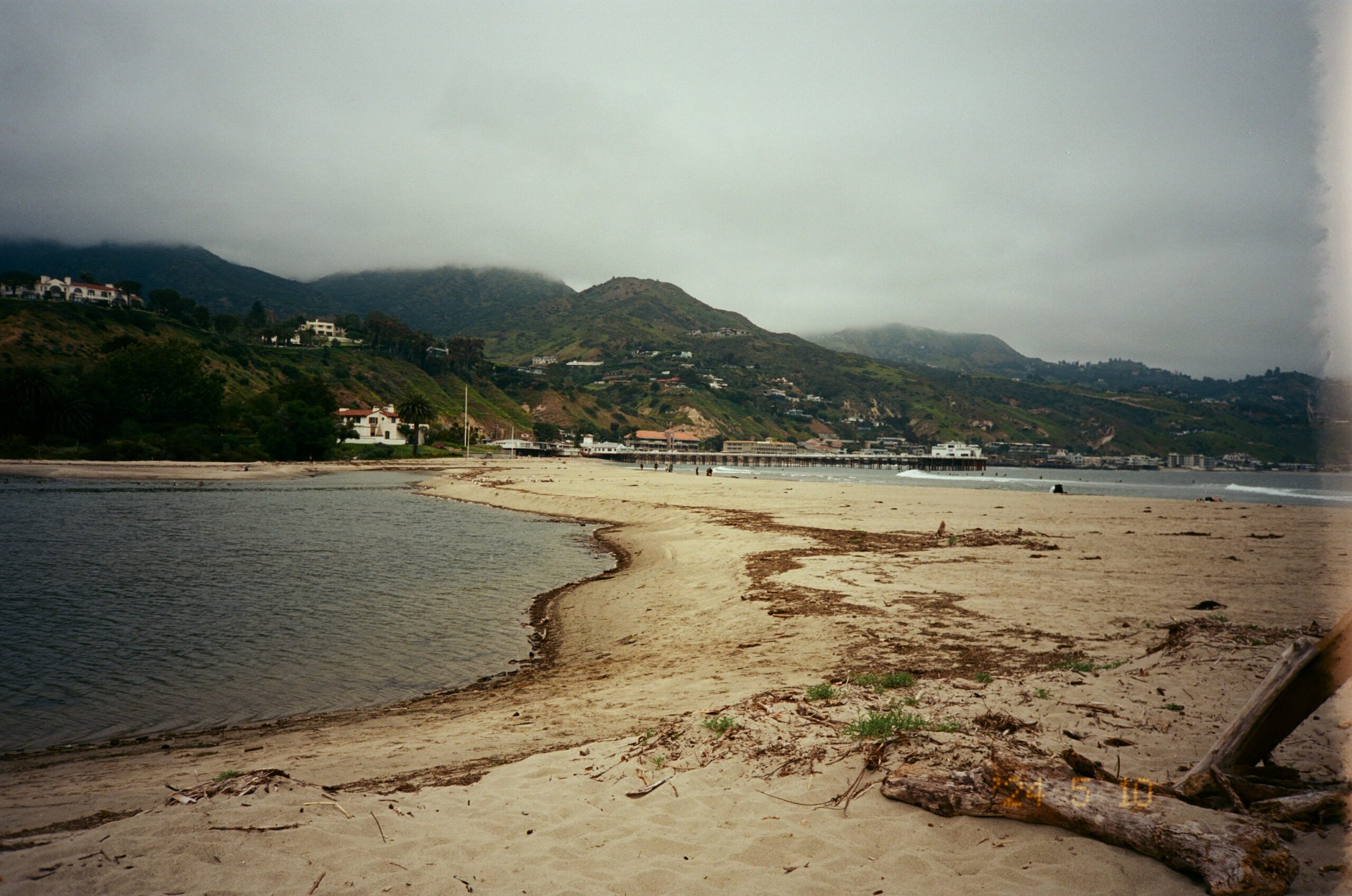
Image of Malibu State Beach by Trinity Catlin
etymology of “shore,” there is a possible connotation of severance and separation. Chopin, Nin, and Seuss’s depictions of rebirth on the shore are consistent with the strenuous roots of the shore and Venus. Specifically, the female rebirth evokes both loss and sensuality—a sexual “awakening” that marks the severance between the old self and the rebirth of a sexual self. Furthermore, the orientation of the speaker towards, within, and through the shore marks a linear regression or progression of old and new self.
In Kate Chopin’s novella, The Awakening, the shoreline marks a reversal in time, in which the protagonist, Edna, reverses in age as she moves down the shore and emerges reborn. In Edna’s rebirth, the shore marks the intermediary between the older self and childhood self—the self that is indoctrinated into patriarchal values and an empowered self. The shore functioning as an intermediary between the culture/nature and patriarchal/liberatory is noted by Sandra Gilbert, who states,
“For Chopin’s Aphrodite, like Hesiod’s is born from the sea, and born specifically because the colony where she comes to consciousness is situated, like so many places that are significant for women, outside patriarchal culture, beyond the limits of the city where men make history, on one of those magical shores that mark the margin where nature intersects with culture” (Gilbert 51).
While Gilbert acknowledges that the shore mediates these binaries, Chopin’s description of Edna’s movement to the sea reveals the shore to be a dynamic, gradual space for Edna to regress to her childhood self. As Edna moves towards the ocean, Chopin writes, “But that night she was like the little tottering, stumbling, clutching child, who of a sudden realizes its powers, and walks for the first time alone, boldly and with over-confidence” (30). As she moves across the shore, towards the water, she returns to a childlike self, with the confidence of a child who doesn’t understand the dangers of the world. She begins her movement, “stumbling,” but as she moves closer to the water, she walks “boldly,” as if she is shedding her older self—embedded in a patriarchal culture—and returns to a younger self. When she swims out, she feels, “A quick vision of death smote her soul, and for a second time appalled and enfeebled her senses” (Chopin 30). This moment marks the change and rebirth of Edna that characterizes the rest of the novella. While the “second time” her senses are appalled could refer to her experience listening to Madame Reisz play the piano, it is also as if she is experiencing a second birth; the sea functions as the space from which she originates, a return to the “other,” subconscious mode of being. Similarly, Gilbert writes, “swimming immerses Edna in an other element—an element, indeed, of otherness—in whose baptismal embrace she is mystically and mythically revitalized, renewed, reborn” (Gilbert 51-52). Just as Venus emerges from the ocean from the castration of a patriarchal figure, Uranus, Edna emerges from the ocean as a sensual being—grown out of the remnants of her male-dominated life.
In purely movement from sea to shore, Anais Nin’s prose poem, The House of Incest, describes the speaker’s birth as a strenuous, oceanic birth akin to Venus. Nin opens the poem with, “My first vision of earth was water veiled. I am of the race of men and women who see all things through this curtain of sea, and my eyes are the color of water” (1). Nin imagines the speaker originating from the sea as if it was a womb-like space—a space that hosts an almost primordial consciousness. Paralleling the birth of Venus, Nin describes how, as the speaker was born, “The lining of a coat ripped open like the two shells of an oyster” (1). Rather than have a smooth rest on the oyster, however, the speaker states, “I awoke at dawn, thrown up on a rock, the skeleton of a ship choked in its own sails” (2). Nin is severed (sheared) from the womb of the ocean, becoming a dead ship—out of its element, and tied on itself. The transition out of the womb, through the “curtain of sea” or the “lining of a coat ripped open,” is allegorized through the movement from sea to shore. The shore becomes the first scene for the speaker to experience the material and cultural order of life on land—it is a place of birth, and experiencing the suffering of the world for the first time. The entity that is reborn isn’t reinvigorated by this birth, but splayed out and damaged. As the speaker moves out of the sea, and up the shore, she moves towards the structures of the anthropocentric world.
In Dianne Seuss’s poem, “Intimacy Unhinged / Unpaddocked Me,” Seuss’s movement towards the shore marks a destructive rebirth by being in proximity to Venus—rather than reimaging herself as Venus. Seuss evokes the image of Venus, stating that, while on the shore, “Love came close anyway, / found me out, its warped music all the rage. It had / a way, just by being in proximity, of opening / the shells of the bivalves. Disclosing their secret / meat” (Seuss 9-13). Rather than imagine herself as Venus, Seuss imagines herself as a victim of Love, or Venus. While in the beginning of the poem she, “didn’t want it” (Seuss 1), love “found” her out—causing a transformation, or rebirth within her. The music of Venus is “warped” and wild. Just as Venus, in some images, emerges from a shell, Love opens “the shells of the bivalves,” evoking vulvic, sensual imagery. Seuss illustrates her movement towards the shore as a space in which, despite what she wants, Venus is able to create change within her—a rebirth. Love is allegorized as the shore, in which the colliding forces of land and sea—death and love—break down the subject, or shore material, and cause a rebirth.
Feminine relationality to the shore, for Chopin, Nin, and Seuss, is not purely articulated as a rebirth of the self; it illustrates a uniquely sensual and sexual liberation from patriarchal values. Scholarship on the beach, and the shore reflect western culture views the shore as a space for eroticism. Fiske illustrates how the cultural practices at the beach—swimming and tanning—inform our perceptions of the space itself,
“The beach, with its structure of the natural, legitimates this sexual display and look: the body is permitted a visibility within this anomalous strip that is denied it in more culturally central environments, and the body, of course, is where we are closest to nature. Sexuality may be “natural” in its origins, but the forms by which it is expressed are specifically cultural, however much this may be disguised” (Fiske 41-42).
Just as western cultural perceptions of the shore view it as a space between nature and culture, the presentation of the body, similarly, does not neatly fit on either side of the binary. Furthermore, this presentation of the body is policed by western culture. Fiske notes that clothing, typically, functions as a way for humans to differentiate themselves from animals (45). At the beach, “The naked body is nature—what man shares with animals—the clothed body is culture. But my point here is that as dogs cross and dirty the physical boundary between man and beasts, so breasts cross and dirty the conceptual one. Both are therefore appropriately banned or permitted together” (Fiske 45). Nakedness on the shore, for women specifically, signifies a kind of animalism that is policed. Sexuality and the female body is interestingly caught between the cultural practices of the beach, and misogynistic, othering views of women and animals. It is logical, therefore, that the shore invites an expression and transgression of socially accepted female sexuality—and that this transgression is transformative.
Edna’s complicated relationship to sexuality, throughout The Awakening, is expressed through shoreline imagery—pulls and collisions—in which her relationships to domestic life and sexual freedom deconstruct her relationship to self. The shore, like Edna, is exposed and subjected to shifts within the land, figures within her domestic life, and the sensual push and pull of the ocean. Edna, like the shore, is in a constant state of being stretched apart, beaten by waves, witnessing debris, and is “rebuilt” or reborn by the destruction of landmass. Moments of ecstasy appear as oceanic collisions—like a wave beating down on the shore. When Edna first hears Madame Reisz play the piano, for example,
“The very first chords which Madame Reisz struck upon the piano sent a keen tremor down Mrs. Pontellier’s spinal column…She saw no pictures of solitude, of hope, of longing, or of despair. But the very passions themselves were aroused within her soul, swaying it, as the waves daily beat upon her splendid body. She trembled, she was choking, and the tears blinded her” (Chopin 28).
Here, the shore is allegorized in Edna’s body as she listens to music. Her body is subjected to “the waves daily beat upon her,” like she is the sand being deconstructed by the tide. She trembles, chokes, and is blinded by the experience—simultaneously personifying the shore as a body being deconstructed, and illuminating the gravity of Edna’s sensual experience. It is not merely sensual, it is embodied, natural, and orgasmic. The cultural implications of the shore as a space of eroticism inform Edna’s experience of a transgressive, abnormal experience of sexuality. Oppositely, descriptions of Robert, Edna’s love interest outside of her marriage, is oceanic—characterized by separations and reunions, or the push and pull of the tide. In one description of Robert, “His hair—the same color as hers—waved back from his temples the same way as before” (Chopin 99). In this moment, Robert’s hair “waved back” as if it was a retreating tide. Chopin experiences Robert as an embodiment of the shore, in which she is subject to his movement. Interestingly, Robert experiences Edna as the ocean as well, revealing both figures as embodiments of the shore as an allegory for transgressive sexuality, “Her seductive voice, together with his great love for her, had enthralled his senses, had deprived him of every impulse but the longing to hold her and keep her” (Chopin 181). Just as Edna trembles at the oceanic sound of music, Robert experiences her voice as what Chopin similarly describes, “the seductive odor of the sea” (Chopin 75). The characters’ intimate and sexual relationships to one another is described as a reciprocal relationship between land and sea. Both characters experience their affair, and sexuality on the periphery of culturally accepted society—as if they were the shore. [2]
The female sexual body is similarly illustrated as the shore in Nin’s The House of Incest. In a dreamlike narrative fashion, after the speaker is born and thrown onto shore, she is immediately met with an intimate sexual encounter with Sabina. The speaker describes the encounter, stating, “From all men I was different, and myself, but I see in you that part of me which is you. I feel you in me; I feel my own voice becoming heavier, as if I were drinking you in” (Nin 26). The boundaries between bodies, like water soaking into sand, is transgressed as the speaker writes, “I see in you that part of me which is you.” Everything is enmeshed, with the “I” in “you” and the “you” is “I.” Furthermore, intimacy is expressed as “drinking” the other person in—as if one entity is being dissolved into the other. Sexuality and intimacy is expressed like the relation between sand and water—enmeshed and deconstructive. In another moment, the speaker imagines herself inside Sabina, “One woman within another eternally, in a far reaching procession, shattering my mind into fragments” (Nin 22). Just as Edna and Robert appear to one another like sand and sea, the speaker and Sabina oscillate between being enmeshed with one another. With the acts of two women being “inside” one another, being deconstructed, and enmeshed—the separation between the two women signifies a Freudian birth and death through sexuality. They exit one another, like a child departing from the mother’s body, and experience an emotional “death.” Furthermore, the intimacy between Nin and Sabina has destructive force, “shattering the mind into fragments” like the waves of the ocean breaking stone, shells, and debris into shore. The body and mind becomes a landscape being deconstructed as an act of sexuality.
Seuss’s relationship to sexuality is also expressed through the landscape of the shoreline as both intimate and cataclysmic. Seuss opens the poem, repeating her title, stating, “Intimacy unhinged, unpaddocked me. I didn’t want it” (Seuss 1). She describes her interaction with intimacy through negation and absence. It unhinges, unpaddocks, and undoes her—illustrating both a sense of openness and a sense of loss about what once was. After the “secret / meat” (12-13) is revealed to Seuss, she states, “One doesn’t really suck on frozen sugar water. / One allows it to melt in the oven of the mouth,” (Seuss 13-14) implying that she eats the inside of the bivalve. Her differentiation between the agency in “suck” and the passivity in “melt,” illustrates how love, intimacy, and sexuality is a force that acts upon the individual, rather than a concept one participates in. Seuss’s depiction of Love as an abstract entity with agency and her final two lines, informs and is informed by the setting of the shore. The forces of the shore—hydraulic, geologic, and more—are similarly forces like Seuss’s Love, which acts upon her. She explores her relationship to sexuality, intimacy, and love on the shore—which reflects back how her desires and love are a natural, agential force outside of her control.
Chopin, Nin, and Seuss experience sexuality as a simultaneous death and rebirth. All of the authors describe a transformation that is oriented by and around the shore. However, their sexual awakenings and rebirths are not painless experiences—they illustrate feelings of delusion, chaos, and being undone. For Chopin and Nin, their experiences of sexuality and rebirth also incorporate a sense of being “shoreless,” or, “Of a sea, or what is compared to sea: Boundless” (“Shoreless, N1”). The use of the word, “shoreless,” importantly, is not limited to one’s physical orientation of the shore, but one’s mind-body connection. The OED quotes Rudyard Kipling’s use, for example, in which he states, “He was adrift on the shoreless tides of delirium” (Kipling, qtd. in OED). For Chopin and Nin, their final, deathly moments reveal a complete departure from shore, and being consumed by the ocean. Seuss, however, experiences death on the shore through debris—through the deconstruction of the setting itself. In all cases, however, sex, birth, and death intertwine themselves in the same images and moments—disillusioning the boundaries between them.
In The Awakening, Edna decides to depart into the sea as a complete departure from her domestic life. In the essay, “The Multisensorial Beach in Kate Chopin’s The Awakening and Charles Simmon’s Salt Water,” Virginia Richter illustrates how the shore functions as both sensual and deadly for Edna through multisensory experience. She illustrates how the shore invites both a significations of health and death, writing, “the beach is culturally coded as life enhancing, healthy, and sensuous; at the same time… this heightened sensory engagement is also linked with death” (Richter 494). The contradictory forces Edna experiences, and her sensory engagement invites a sense of “delirium” and desire to be “shoreless.” As Richter writes, “The delirium Edna seeks is first sampled in the sensual waves of Grand Isle, emphasizing how profoundly the summer place can inspire the reevaluation of self and home” (Parmiter 12). Edna wants to be “shoreless,” to abandon her attachment to land, and be consumed in the delirium of the sea. This passage can be read as both a return to the womb, and a death. Paralleling, again, the birth of Venus, Edna enters the ocean naked—like Venus and like an infant. Furthermore, Chopin describes, “The foamy wavelets curled up to her white feet, and coiled like serpents around her ankles” (Chopin 116), which alludes to the waves that birthed Venus in both painting and the Hesiod. Rather than return to shore, however, Chopin narrates, “She went on and on. She remembered the night she swam far out, and recalled the terror that seized her at the fear of being unable to regain shore. She did not look back now, but went on and on” (Chopin 116). Edna returns to the birthplace of sexuality and love—Venus—with out the objects, like women’s accessories and clothes, that signify her adulthood. In doing so, she propels herself to be reborn by creating her own death. To be “shoreless,” therefore, ends the cycle and collisions between sex, death, and birth in a final moment of delirium.
In The House of Incest Anais Nin’s speaker expresses sexuality as a death, and feeling of being shoreless. To her lover, Sabina, the speaker commands, “Disrupt the brown crust of the earth and all the sea will rise; the sea-anemones will float over my bed, and the dead ships will end their voyages in my garden” (Nin 32). The speaker encourages Sabina to break open the earth’s crust and drown her—a metaphor for being consumed and drowning in the other. She does not wish for any shore, whether the “shore” is her bed or the beach she was born onto. She echoes this sentiment of sexuality and death, writing, “Your beauty drowns me, drowns the core of me” (Nin 25). For the speaker, immersing oneself in the ocean—abandoning the shore—is an all-consuming act of love. Since Nin describes the speaker being born out of the water—the return to being “shoreless” is both a death, sexual act, and return to the womb.
A final definition of shore reveals the debris found on the shoreline to be culturally specific, and informative to Seuss’s imagery of the shore. One definition of “shore” is described as, “Originally in common shore=common sewer” (“Shore, N4”). The shore is also a space for waste, and debris to collect—a sewer. Paralleling this, Seuss describes “I fled / to the shore and saw how death-strewn, all the body / parts washed up and sucked clean like that floor mosaic / by Sosus of Pergamon, Unswept House. Seabirds / flocked and dematerialized like they do” (Seuss 4-8). Seuss’s shore is filled with dematerialized bodies of humans and birds. Her reference to Sosus of Pergamon’s Unswept House, a mosaic depicting eaten foods after a feast parallels these images. Just as the shore is constituted by the cycle of dematerializing matter, Seuss sees and experiences herself being dematerialized by Love. It is invasive, deconstructive, and causes a rebirth. The shore, in definition and depiction, is treated like a place of waste, a space that breaks down parts, scraps, and pieces—assembling it into something new. For Seuss, this too is an erotic experience of death and rebirth.
In all three texts, the female speaker and body experiences the shore as a sensual space that generates rebirth and death. While certain aspects of the pieces differ, they share the disillusionment of boundaries between these typically linear experiences. The materiality, process, and cultural implications of the shore reveals itself in the writings of Chopin, Nin, and Seuss. Just as the abrasive relationship between land and sea generates and changes the shoreline, the forces on the shore generate a deconstruction within the author’s speakers and characters. While this comparison between the shore, its definitions, and the authors reveals an intertextuality between reading the shore and reading the texts, it is also, crucially, a western, cisgendered, female perspective. The speakers and characters, similarly, experience a transformation out of the repression of their own sexual desires within the context of patriarchal societies. Ultimately, the “excess of meaning potential” (Fiske 34) of the shore invites and necessitates more intertextual scholarship between literature and the shore to include further perspectives, cultures, and experiences.
