
Oceanic Sublimity in Kate Chopin’s The Awakening
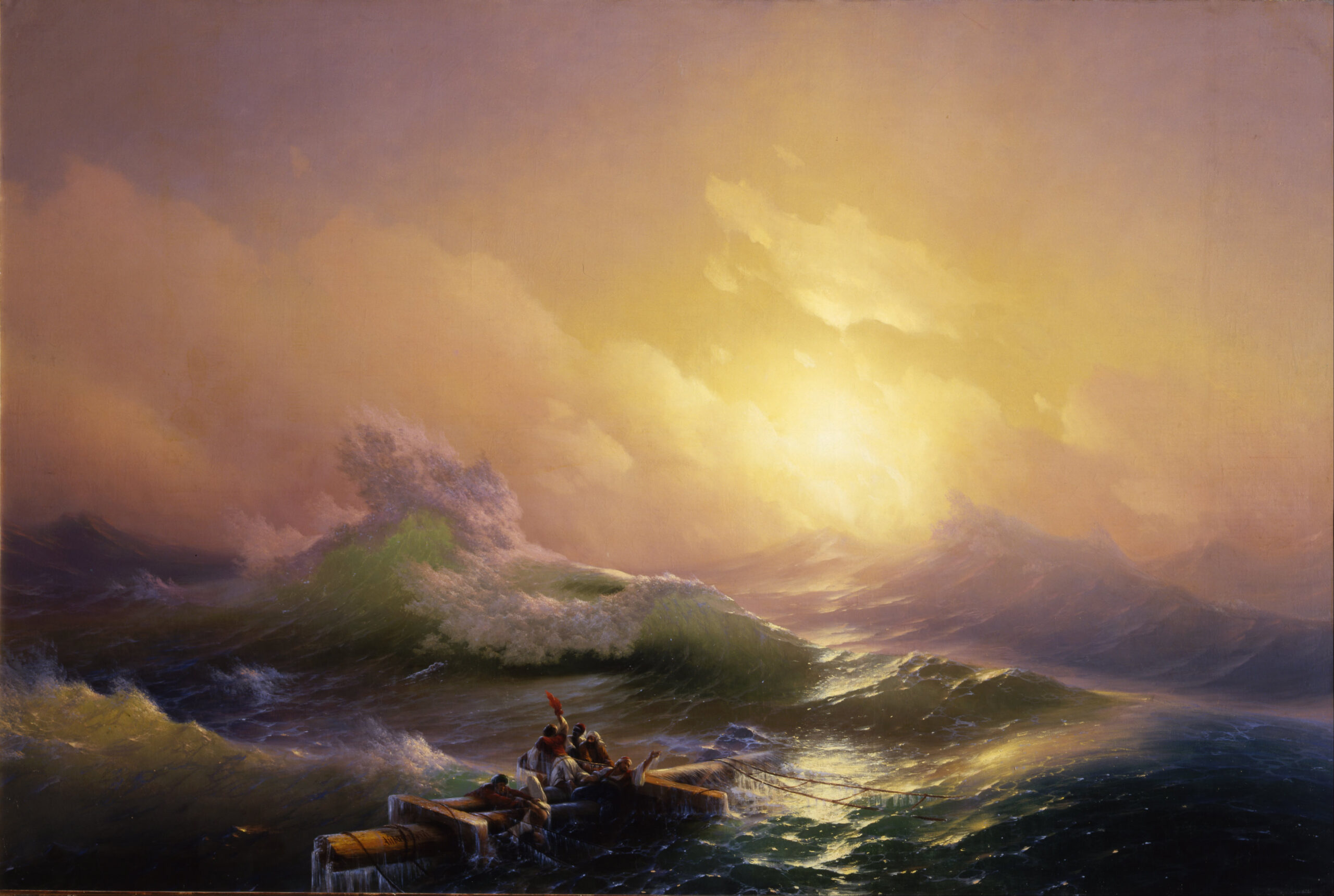
The grandeur of the ocean cannot go unacknowledged by humanity. The undiscovered
depths that exist beneath its surface. Creatures that have yet to be categorized in the scientific
journals of tomorrow. Its dangers can envelop and overturn an entire “unsinkable” vessel down to
a delicate and “bewildered” woman. How can such complexity of might, beauty, and wonder be
captured? How can it be defined verbally? Artistically? Or even spiritually. The word sublimity,
an extension of the word sublime, has often been associated with the wonders of nature by
individuals who dare to see it for themselves or even attempt to capture such a spectacle within
their artistry. In Kate Chopin’s novel The Awakening, initially published in 1899, the main
character, Edna Pontieller, undergoes several experiences with the oceanic sublime that lead to
her revelations concerning the woman she aspires to be and the type of dutiful wife societal
norms expect her to perform. A journey of self-exploration can generally be viewed as a positive
experience to the average human, for it is often assumed to result in personal growth.
Nevertheless, if an individual’s environment does not cater to the needs of this newfound self, it
can often end in isolation and disaster. In The Awakening, the oceanic sublime catalyzes Edna’s
self-discovery but also exposes the gendered limitations of her liberation, as societal norms
prevent her from fully embracing the sublime experience and ultimately lead to her fated death in
the sea.
ETYMOLOGY OF SUBLIMITY
According to the Oxford English Dictionary, the word “sublimity” has multiple origins,
taking partly from Middle French and Latin languages and tracing its origins to the French word
sublimité, meaning “excellence” or “perfection.” It is derived from the 12th-century Old French
word sublimiteit, meaning “high position” or “altitude”. When it comes to its Latin origin, there
is a more profound history. The word sublimity’s Latin origins can be connected to the word
sublīmitās, meaning “elevation,” “elevated state of mind,” “sense of exaltation,” “magnanimity,”
or “grandeur of style.” Within post-classic Latin around the late second to the early third century,
sublīmitās is understood as someone who has a “high position” and later evolves in the sixth
century to being used as a “title of respect.” Specifically, this word was applied when “addressing
a person of high rank or status.” Configured of two parts: the first being sublīmis, meaning “high
up” or “elevated,” and ‑tās, which is a suffix borrowed from the original French -te that later
evolves into the more commonly used suffix -ty found in words like “beauty,” “loyalty” and
“royalty.” Overtime, the definition of sublimity evolves from the description of an individual of
high status and the physically high positioning of something, to a height in emotion. In the late
1500s, sublimity began to make its appearance in literature and philosophical critiques
concerning the “greatness of artistic or intellectual conception.” In the mid-17th century,
sublimity was beginning to have relation to that of nature and artistry, particularly the human
experience of both and the types of overwhelmingly “high emotion” that could stem from
witnessing such “great beauty” or “grandeur” (Oxford English Dictionary). Its definition evolved
from association to “nobility or greatness of nature, character and conduct” in 1429 to its more
common affiliation with “a sublime feature or aspect of nature or art” in 1778. The word
sublimity evolved from its connection to certain humanity’s grandeur to more powerful aspects
of life that resonate with one’s spirit, mind, and body no matter what status a person fell under in
society, leaving them in a state of overwhelming emotion due to such indescribable presence.
Oceanic sublimity, the word “oceanic,” meaning “resembling or relating to the ocean” (Oxford
English Dictionary), is a specific adjective applied to something, comparing it to the robust
nature of the ocean. The combination of these two words together creates a compelling phrase
that does the utmost to elucidate the ocean’s omnipotence.
OCEANIC SUBLIMITY IN THE AWAKENING
While the oceanic sublimity plays a variety of central roles throughout Edna’s journey of
self-discovery within the plot of The Awakening, there are two key chapters where she immerses
herself within the sea, experiencing the sublime visually and physically. In Chapter 10 of the
novel, Edna takes her first swim off the shore at night, finding a new sense of courage to glide
into the sea without any outside aid. Chopin describes her main character’s submergence as “like
the little tottering, stumbling, clutching child, who of a sudden realizes its powers, and walks for
the first time alone, boldly and with over-confidence” (30). According to the article, “Taking the
Waters: The Summer Place and Women’s Health in Kate Chopin’s ‘The Awakening‘” by Tara K.
Parmiter, women in these summer places like Grand Isle often found new expressions of freedom
and undiscovered sensations. Parameter writes, “Edna’s freedom to move her body to the rhythm
of the tide, to learn how to coordinate her arms and legs to move within a new medium: these
were trills only recently embraced as leisure activities for vacationing American women” (6).
Edna’s first swim is a key scene in the novel where she experiences aspects of sublimity:
gathering an impression of space and solitude, which the vast expanse of water, meeting and
melting with the moonlit sky, conveyed to her excited fancy (30). The surroundings of oceanic
nature provoke sensations of wonder and awe for Edna, where she feels inclined to “reach out for
the unlimited in which to lose herself” (Chopin 30). There exists an essential mood Chopin
creates with her language, one that falls within what is implied when an individual experiences
the sublime. Basking in the presence of great beauty, Edna discovers this new power of the self
she was not aware existed within herself. The last chapter provides immense complexity within
its very last pages but primarily focuses on Edna’s experience of the sea. Chopin narrates a
bittersweet ending for Edna as she takes the waves one final time. Describes how Edna continued
into the water despite its chilling temperatures and bottomless depths, noting how “the touch of
the sea is sensuous, enfolding the body in its soft, close embrace” (Chopin 116). There is an
openness and vulnerability to the elements, resembling a symbolic example of release through
her nakedness. With no garments to protect her body in any human way possible, Edna embraces
the sublimity of the sea. Relinquishing herself to its overpowering strength, out of reach from the
comfort of the shore, resulting in her overall strength subsiding.
EDNA’S COMPLEX EXPERIENCE OF SUBLIME
Despite the emotional profoundness that the ocean has on Edna with both of her
submersions, it cannot be ignored that there existed a sense of danger when she took her first
swim and then evidently concludes her story when she drowned in the sea. Even though defining
sublimity is frequently intertwined with astonishment and wonderstruck when in the presence of
nature, there is also terror, seclusion, and personal endangerment that an individual can undergo
witnessing such magnitude of power. During her first dive, Edna notes how “a quick vision of
death smote her soul, and for a second of time appalled and enfeebled her senses” (Chopin 30).
Here, Chopin writes about another common emotional factor of one’s experience of natural
sublimity: fear. Tom Cochrane’s article “The Emotional Experience of the Sublime” notes the
varying factors that equate to natural sublimity’s overall psychological hold on the individual.
Referencing to Immanuel Kant’s dynamic and mathematical sublime definitions, “where the
dynamic sublime applies to extremely powerful objects such as storms and the mathematical
sublime applies to extremely large objects such as mountains” (128), Cochrane breaks down both
into being related to feelings of danger and alienation (129-130). Edna falls into both categories
when it comes to her life-altering interactions with the ocean, so where can the ocean be placed?
Unlike mountains and sunrises, the sea is ever-changing and can rarely be considered a factor of
nature that humanity can rely on staying in an unvarying state. Thus, Edna’s events of sublimity
can correlate with several of Cochrane’s sublime models. The first is the heroic model, claiming
“we enjoy our capacity to engage with the sublime object, providing an enhanced recognition of
our powers” (134). Edna can resonate with this model as she expresses during her first swim
while out at sea that “a feeling of exultation overtook her, as if some power of significant import
had been given to her soul” (Chopin 30). Her submersion into uncharted territories as a woman
invigorated an aspect of the self that Edna had not realized was in her. Leading her later on in the
novel to rebel against societal norms, defy her husband’s wishes, and concentrate on her escape
through artwork. While the ocean continues to inspire Edna throughout the months spent at
home, where she often thinks of Grand Isle, the final chapter, where she meets her end in the
ocean’s sublimity, falls under the humble model. Cochrane claims this example to be executed
“by absorbing oneself in the sublime, one can forget the petty struggles of the world for awhile”
(136). Once Edna leaves Grand Isle, returning to the urban environment of New Orleans, she
becomes restless and isolated in her dissatisfaction with her surroundings. “It seemed to her as
life were passing by, leaving its promise broken and unfulfilled( Chopin 75). With her continuous
disdain for life, especially once Robert Lebrun bids her farewell through letter form, she travels
back to Grand Isle in search of the sea to escape her limited existence as a woman. Edna’s
experience within the sublimity expands beyond just a liberating sensation and emphasizes that
the sublime can place an individual’s life in jeopardy (Cochrane 129-130).
ART AND SUBLIMITY
Prior to both what appears as the “beginning” of Edna and the tragic end, she becomes
more in tune with her identity as an artist once she experiences the sublimity of the ocean at
Grand Isle. The narrative Chopin creates for Edna and her art shares similar emotional affairs
that historical artists have documented throughout history. The article “Seascapes of the Sublime:
Vernet, Monet, and the Oceanic Feeling,” written by Steven Z. Levine, dissects various artists’
experience of the sublime, particularly the oceanic sublime, through their produced work and
writings. Comparing and contrasting with Kant’s definitions of the sublime, Levine’s focus on
Claude Monet’s sublime experience is similar to Edna Pontieller’s artistic frame of mind in The
Awakening. While Edna painted at her home in New Orleans, the sounds and images of the sea’s
natural artistry “moved her with recollections” (Chopin 60). Remembering specific aspects that
could only belong to the summer place, “a subtle current of desire passed through her body,
weakening her hold upon the brushes and making her eyes burn” (
Chopin 60). These complex feelings relate to that of the
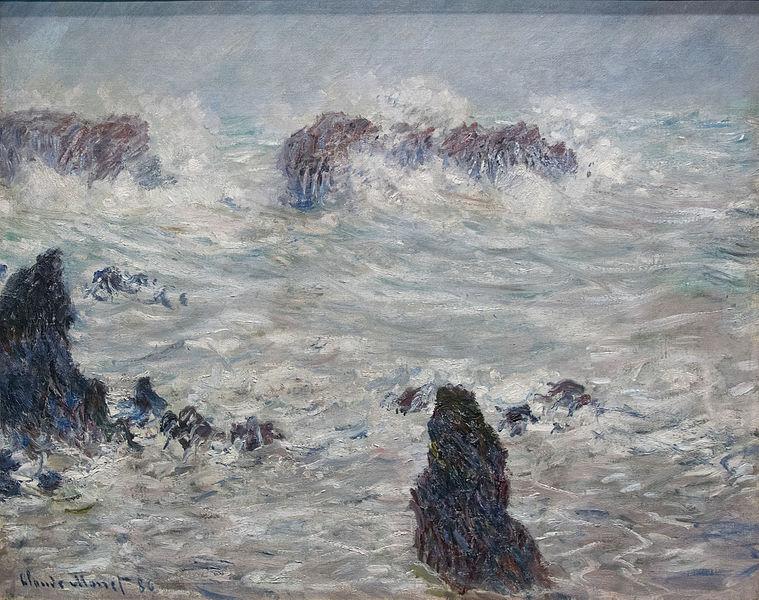
documented time Monet spent at Belle-Île, an island off the coast of
France, where he described it to be “tragic, sinister, diabolical, but
superb; savage, fantastic, lugubrious, and yet delicious; terrifying, terrible, astonishing, but
colossal and grandiose” (Levine 378). Words that fall within the experience of the sublime,
without applying sublime within his description, just further enhance the magnitude of impact
the ocean can have on one’s soul. Another influential philosopher, Schopenhauer, comments on
the relationship between art and the sublime (Levine 392-393). His observation proves how,
despite whether the sublime object threatens an individual with its power or immeasurable size,
they can still find beauty within these scenarios. Experiencing the sublime, asks the individual to
set aside their desires and concerns, resulting in one’s rise above into a different state of spiritual
acknowledgment. This can coordinate with Edna’s final thoughts in the sea as she reminisces on
her sister’s and father’s voices. Describes how “the old terror flamed up for an instant, and then
sank again” ( Chopin 116). Edna looked past her safety concerns and found tranquility and a state
of mind for reflection where many would find fear of losing their lives.
MASCULINE VS. FEMININE SUBLIMITY
While Edna does share similar sentiments with Monet and Schopenhauer concerning
oceanic sublimity, due to her place as a woman in society, she is restricted from complete
immersion into her sublime. Ultimately, these social restrictions place her newfound self in a
hostile environment that pressures her to seek the furthest freedom possible at Grand Isle, the
place where she feels most alive. Due to her influence on her newfound self, being only a white
male figure to look to, Edna finds difficulty placing herself into shoes that are not a perfect fit. In
the novel, once Edna is transformed from her encounter with the ocean’s sublimity, she immerses
herself within her art and adopts a masculine view of the world and women around her. Molly J.
Hildebrand, author of the article “The Masculine Sea: Gender, Art, and Suicide in Kate Chopin’s
The Awakening,” explores Edna’s adoption of the masculine artist perspective and how this
ultimately contributes to her doom. Hildebrand writes, “she desires not a fundamental change in
the racial, class, and social system of her world, but simply the elimination of the barriers which
prevent her from accessing all the vestiges of white masculine privilege” (190). These barriers
become more apparent when comparing Edna to the male artist of Monet. A significant
difference between Edna and Monet as artists, besides their gender, is the expected duties each
has set in stone for them based on what is ruled acceptable by society. Edna is forced to leave
Grand Isle at the summer months’ end, abandoning the living place of her muse and “birth.”
While, as a man, Claude Monet’s expedition to Belle Île was set for two weeks, which ended up
being a two-month-long stay(Levine 392). His time there left him with the impression that he
tarnished the unattainable goal he had set with his works. This luxury would not be one Edna
would have the freedom to indulge in. With her status as a wife and a mother, she is expected to
perform these duties first, unlike Monet, a man solely with a mistress and no other
responsibilities outside his work and passion. Edna’s feminine sublime lies within her experience
of uncharted waters and so is Monet’s in his collection of oceanic sublime paintings. However,
his masculine sublime can be further explored with any outside restrictions on him as a man.
THE LIMITATION ON EDNA’S JOURNEY
Due to her limited influences as an independent artist in society and her disconnect from
the place by the summer sea, Edna only has the male frame of mind to mimic in her quest for
self-fulfillment, resulting in conventional obstacles she cannot conquer as a woman. As her
enlightenment separates her from the female influences around her, Edna has no one to look to
for guidance who can balance the masculine and feminine aspects of the self. She falls into a
state of mind, holding herself above all women for her newly gained knowledge about the self
that extends beyond what society wants from women. We see this in her gaze of Madame
Ragnatoille, consistently simplifying her looks as a “faultless Madonna” ( Chopin 13). Her other
influence was Mademoiselle Reisz, “a disagreeable little woman, no longer young, who had
quarreled with almost every one, owing to a temper which was self-assertive and a disposition to
trample upon the rights of others” (Chopin 27). Even though she often finds comfort in her
artistry going to Reisz for inspiration or companionship, Edna cannot fully relate to a woman
who lacks a husband and children, can live a life free of burdens, and is simultaneously viewed
as an undesirable female. In the article “The Nullification of Edna Pontellier” by Katherine
Kearns, there is an emphasis placed on Edna’s attempt at the adoption of a masculine “mirror”
(65). With her devaluing of the individuals around her, Edna isolates herself into dangerous
territory. The solitude luxuries of middle-class white men are out of reach for Edna as a woman.
Kearns explains, “The sublime is an aesthetic version of nihilism in which one perceives in the
impossibility of objectifying concepts’ the ‘lack of reality’ of reality.’ And Edna systematically
nullifies herself as she nullifies others in her search for the masculinely defined grail” (76-77).
Edna’s desire to place herself within this masculine stance enables her with a different power to
disassociate from those around her who cannot be the stimulus she desperately craves. Besides
the surrounding human influences that fail to align with Edna’s needs, her placement back in
New Orleans does not align with the urge for sublimity by the seaside. Her moods become
inconsistent as she searches for fulfillment in her old lifestyle. Chopin writes how Edna was
“seeking herself and finding herself in just such sweet, half-darkness which met her moods” (54).
The voices that follow her while she is home were not calming, unlike the sensuous voice of the
sea, but instead described as mournful and lacking any notes of hope (54). Her disconnect from
the stomping grounds of Grand Isle, where the oceanic sublime expanded her sense of reality,
withers Edna into a state of disengagement—provoking her to seek the shores where the summer
met its end so she can willingly follow.
CONCLUSION
The elaborate interactions between oceanic sublimity and societal constraints in The
Awakening underscores the profound complexity of Edna Pontellier’s journey. Through her
encounters with the sea, Edna experiences an arousement of previously unmarked desires and
individuality, an awakening into an abyss of her own. However, as Kate Chopin illustrates
through Edna, the sublime is a source of inspiration and a potential chasm for grave
consequences. The duality of the sublime—its capacity to elevate and isolate—is meticulously
tethered within Edna’s ultimate fate. Her inability to reconcile her newfound sense of self with
the rigid expectations of her environment leads to her tragic end, a final surrender to the sea that
once induced her thirst for freedom. A deeper exploration of the masculine versus feminine
sublime highlights the gendered limitations of Edna’s liberation, revealing a deeper
understanding of the societal constraints faced by women of her time. Ultimately, Edna’s story
serves as a cautionary tale of the sublime’s power: an awe-inspiring force that can spark
transformation but also demand the ultimate sacrifice when the structures of mankind refuse to
accommodate a young woman’s personal growth.
Works Cited
Chopin, Kate. The Awakening. Edited by Margo Culley, W.W. Norton & Company, 2018.
Cochrane, Tom. “The Emotional Experience of the Sublime.” Canadian Journal of Philosophy, vol. 42, no. 2, 2012, pp. 125–48. JSTOR, http://www.jstor.org/stable/43297871.
Hildebrand, Molly J. “The Masculine Sea: Gender, Art, and Suicide in Kate Chopin’s The Awakening.” American Literary Realism, vol. 48, no. 3, 2016, pp. 189–208. JSTOR, https://doi.org/10.5406/amerlitereal.48.3.0189.
Kearns, Katherine. “The Nullification of Edna Pontellier.” American Literature, vol. 63, no. 1, 1991, pp. 62–88. JSTOR, https://doi.org/10.2307/2926562.
Levine, Steven Z. “Seascapes of the Sublime: Vernet, Monet, and the Oceanic Feeling.” New Literary History, vol. 16, no. 2, 1985, pp. 377–400. JSTOR, https://doi.org/10.2307/468752.
Parmiter, Tara K. “Taking the Waters: The Summer Place and Women’s Health in Kate Chopin’s ‘The Awakening.’” American Literary Realism, vol. 39, no. 1, 2006, pp. 1–19. JSTOR, http://www.jstor.org/stable/27747228.
“Oceanic, Adj.” Oxford English Dictionary, Oxford UP, December 2024, https://doi.org/10.1093/OED/5500853710.
“Sublimity, N.” Oxford English Dictionary, Oxford UP, June 2024, https://doi.org/10.1093/OED/1274785998.
