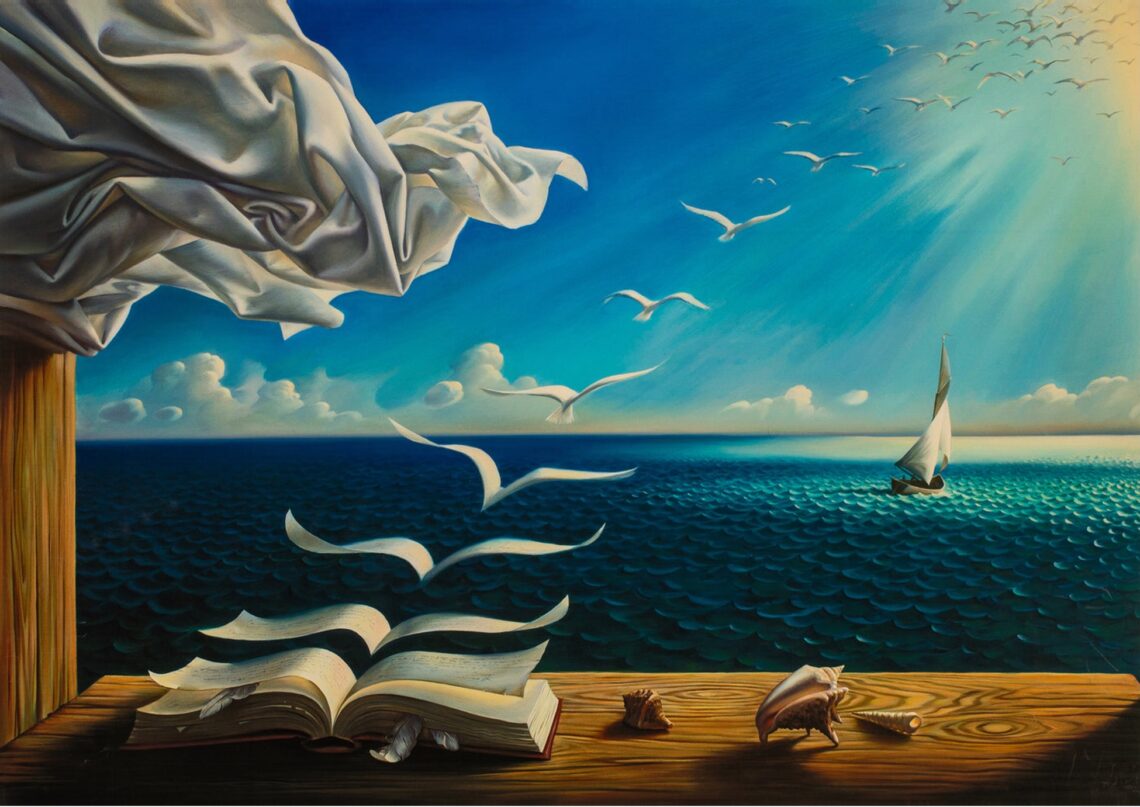
Reading the Ocean
Dr. Miskolcze
Fall 2024
Assignment description and rubric
Digital glossary/keyword project:
For our final class project, you will collaborate on the creation of a WordPress site to create a digital keyword glossary and literary analysis. Your keyword is a term we have found while reading and analyzing our primary and secondary sources in this class. As you learn about creating a digital presence, you will also be encouraging public and scholarly attention to blue humanities and/or reading the ocean. Your keyword entry should help a reader understand a particular literary text (or several literary texts) in a compelling, critical, and creative way. Each of you might frame your investigation into your keyword using different genres or modes (a traditional research essay, a hybrid personal/research essay, a video essay, or a critical/creative presentation), but below is the base requirement for each entry. You will be responsible for the design of your page and presentation of the materials, so images and other multimedia are encouraged. The integration and uploading of your materials fulfill the course objective: “Students will learn how to compose public-facing scholarship with a final digital project.” The project itself is a culmination of other achievements in the remaining course objectives listed on the syllabus.
Your keyword essay should include:
- Multiple definitions and etymology of the term (use the OED for etymology and scholarship we explored in class or on your own).
*see the links on page two for more ideas/examples
- An explanation of how this term can help us read certain literary texts in a more nuanced and complex way (integrate scholarship that contributes to your interpretations and or reads the text differently than you do).
*compare/contrast its appearance in 2 or more texts or how it is mobilized in one text
- Grad students (and optional for undergrads): Examples of this keyword in blue humanities scholarship (see the extensive bibliography attached to the syllabus).
- All entries must have appropriate source attributions (footnote, caption, in-text citation AND Works Cited).
Length: 7-10 pages for undergrads; 10-12 for graduates and 4+1. If you choose to write a seminar essay, limit to 17-20 pages.
Rubric is attached.
Annotated bibliography (undergrads) and bibliography reflection (graduates)
Undergraduates will turn in an annotated bibliography that accurately cites the sources you cited in your keyword analysis (you do not need to annotate the primary texts; only add them to your list). An annotated bib is a 2-3 sentences summary of the source followed by 2-3 sentences describing its usefulness to your project.
Graduate students will write a two-page bibliography reflection on the sources cited and consulted and their relationship to your working thesis. In your opening paragraph, state which ideas and/or contexts most influenced your project’s thesis. The rest of the essay explains how they impacted your analysis.
***
Roots for this assignment:
Creating a cultural glossary of keywords not only has deep roots in the process of archiving language and ideas (dictionaries, encyclopedias, etc.), but also has origins within the field of cultural materialism, exemplified by Raymond Williams and his seminal work Culture and Society and Keywords: A Vocabulary of Culture and Society. Listing keywords that have evolved in meanings through time and usage, Williams exposes how a word powerfully contributes to the ideological and material contexts of its particular moment of circulation. See this collaboration between the University of Pittsburgh, the University of Cambridge, and the journal Critical Quarterly for a more recent digital reinvention of Raymond’s keywords project. The final project for this class was partly inspired by the following:
https://keywords.pitt.edu/index.html
For this assignment and due to my interest in developing professionalizing activities in upper division courses, I was also inspired by increasing interest in writing projects about singular objects and animals. Bloomsbury Publishing (which publishes for academic and non-academic audiences) has released a wonderful series entitled Object Lessons with nearly a hundred titles (including Ocean and Whale Song). See https://www.bloomsbury.com/us/series/object-lessons/
for a list of titles. Other microhistories abound recently from books on animals (the whale, eel, octopus for ex. ) to cultural practices and things such as Coal: A Human History, Ice, Pockets, and nearly all of the books written by the popular writer, Mary Roach (Stiff, Grunt, Spook are three examples). In other words, this project is practice for potential future scholarship and writing encouraged by the current market while also building on your literary analysis skills.
Oceanic keywords:
Much as the meaning of particular words often does not remain the same over hundreds of years (or sometimes much shorter time frames), our texts in this class expose different approaches to reading elements of the ocean throughout time and in the current. For example, the cultural connotations and readings of “shipwreck” in Melville’s 1851 America both influence and are redefined in Omar El Akaad’s 2021 novel about refugees, What Strange Paradise. The meaning of “castaway” means different things to different characters, categories such as human/nature alter in an oceanic context, verbs and nouns like “sound” and “wake” form complex networks of land and ocean-based meanings. See, for instance, Christina Sharpe’s In the Wake: On Blackness and Being.
A final example: our website
This assignment is also adapted from Dr. Danica Savonick’s digital assignment in a lower-division undergraduate course on multicultural literature. While you will aspire to write a more in-depth, lengthier analyses for our upper-division/graduate course, the following link gives you an idea of a student-created website that uses keywords. These students collaborated in groups; you will do individual projects but will brainstorm and problem-solve with one another.
| Category | Excellent (20) | Good | Fair | Needs Improvement |
| Research & Definitions | Provides multiple well-researched definitions and etymological history from reliable sources (e.g., OED, scholarly articles). Demonstrates deep understanding of term’s usage in various contexts. | Provides multiple definitions with etymological details, drawing from reputable sources. Some synthesis of varied sources present. | Provides basic definitions with minimal etymology. Definitions are mostly surface-level or overly general. | Provides vague or incomplete definitions. Etymology is missing or underdeveloped. |
| Critical Analysis & Textual Application | Offers insightful, nuanced analysis of how the keyword applies to specific literary texts, with detailed comparisons and contrasts. Uses scholarly sources to frame and deepen interpretations. | Provides solid analysis of how the keyword is applied to literary texts but may lack depth or complexity in comparison. Includes some scholarly references. | Analysis of keyword’s application to texts is superficial or unclear. Limited or no scholarly integration. | Lacks clear analysis of keyword’s application to texts. Analysis is underdeveloped or irrelevant. |
| Argument & Structure | Presents a clear, compelling argument that deeply analyzes at least one primary text. The introduction grabs attention and the conclusion provides thoughtful summary or closure to the argument. | Presents a clear argument with adequate analysis of primary text(s). The introduction is engaging, and the conclusion offers a satisfactory summary. | Argument is somewhat unclear or lacks depth. Introduction is basic, and conclusion provides minimal closure. | Lacks a clear argument. Introduction and conclusion are weak or absent, failing to provide context or closure. |
| Clarity of Writing | Writing is clear, concise, and well-organized. Strong paragraph structure and few to no grammatical errors. Ideas flow logically with smooth transitions. | Writing is mostly clear with some minor issues in flow or clarity. Paragraphs are organized, but some transitions may be awkward. Few grammatical errors. | Writing is somewhat unclear or wordy. Paragraph structure is weak, and there are several grammatical errors or awkward phrasing. | Writing is unclear or disorganized, with frequent grammatical errors. Poor paragraphing and unclear transitions. |
| Source Attribution & Citation | All sources are properly cited (footnotes, captions, Works Cited) in a consistent and professional style (MLA or MLA Chicago). Citations are accurate and thorough. | Most sources are cited correctly, with few minor formatting issues. Proper academic style is mostly followed. | Some sources are cited, but there are noticeable citation or formatting issues. Incomplete or inconsistent citation style. | Citations are missing or consistently incorrect. Lack of attribution to sources. |
| Digital Design & Presentation EXTRA CREDIT POINTS UP TO 10 points | The digital page is visually engaging and well- organized. | The page is well-organized with clear sections. Includes some visual elements that are relevant to the content. | The page has some organizational issues. Visual elements are included but may not always enhance the content. | The page is disorganized or visually cluttered. |
Total Score: _____ / 100 points total